Elastomeric bearings
Do you have a question?
Feel free to contact us using the details below or complete our contact form .
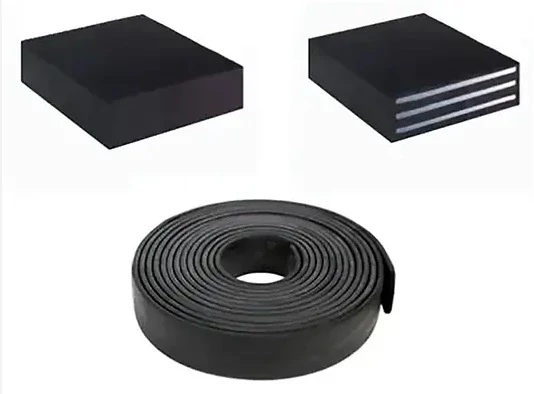
Elastomeric bearings are flexible construction elements used to absorb loads and to allow movements between structural components.
Depending on the application, there are several types of bearings with specific properties:
Unreinforced elastomeric bearings:
Unreinforced elastomeric bearings are used when mainly static loads occur. Available in rolls, in sheet form or cut to size. If a large proportion of dynamic loads occurs, reinforced bearings must be applied.
Textile-reinforced elastomeric bearings:
This type consists of neoprene rubber with two layers of textile. The textile layers act as reinforcement in the rubber so the material can withstand a higher stress. In addition, the textile reinforcement reduces rubber deformation and therefore transmits less horizontal stress to the surrounding structure. This type of bearing is particularly suitable for applications in precast concrete or steel structures.
Unreinforced elastomeric bearings with Teflon (PTFE):
This type is an unreinforced elastomeric bearing with a sliding plate in Teflon, also called a sliding bearing. Sliding bearings provide more free expansion and reduction of the horizontal reaction force. The assembly is surrounded by a polystyrene foam tape. Reinforced elastomeric bearings: these reinforced partially encased elastomeric bearings are used to concentrate large static loads. They can accommodate small rotations and lateral displacements. The core is reinforced with steel plates to increase compression resistance. To prevent corrosion of the edges, these are treated with a special coating.
Reinforced elastomeric bearings with Teflon (PTFE):
This type is a reinforced elastomeric bearing with a Teflon sliding plate. Horizontal movements in the structure are accommodated by deformation of the bearing itself. The horizontal force is limited and depends on the coefficient of friction of the bearing.
Bridge bearings:
The requirements for the different types of bridge bearings are described in the European standard EN 1337. The main function of the bridge bearing is to transfer vertical and horizontal forces from the superstructure of the construction to the substructure. The bearing accommodates rotations and – if required – displacements with minimal resistance.
Do you have questions or would you like a quotation tailored to your project? We are ready to advise you and to provide custom-made solutions.