Custom rubber bearings for construction, precast concrete, and infrastructure
CC Rubber produces custom rubber bearings for buildings, precast concrete structures, industrial applications and machine foundations. From unreinforced elastomeric bearings to reinforced bearings and sliding bearings: each bearing is tailored to your load, application and technical requirements. When certification or the European standard EN 1337 applies, we provide the correct bearing with the required documentation. It is the quality and dedication you can expect from a rubber expert with more than 55 years of experience.
Do you have a question?
Feel free to contact us or complete the form at the bottom of this page.
What are rubber bearings?
Rubber bearings are elastomeric structural elements that transfer vertical and horizontal forces between two construction parts, while simultaneously accommodating rotations and lateral displacements. They form the flexible link between the supporting structure and the supported element: in bridges between deck and pier, in buildings between beam and column, and in machines between frame and foundation.
The choice of bearing type depends on the load profile:
- Primarily static loads: unreinforced elastomeric bearing
- High static loads: reinforced elastomeric bearing
- Large horizontal displacements: bearing with PTFE sliding plate
- Dynamic loads in precast concrete or steel: textile-reinforced bearing
- Bridge structures (civil works): bridge bearing according to EN 1337
Our types of rubber bearings
CC Rubber produces and supplies several types of elastomeric bearings, in standard sizes and custom-made:
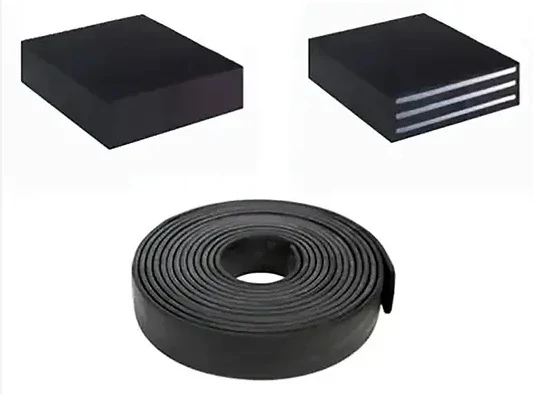
- Unreinforced elastomeric bearings
Used for primarily static loads. Available in rolls, sheet form or cut to size. When a large share of dynamic loads occurs, reinforced bearings are applied. - Textile-reinforced elastomeric bearings
Also called sliding bearings. The PTFE sliding plate allows greater free expansion and reduces the horizontal reaction force on the structure. The assembly is provided all around with a polystyrene foam band. - Reinforced elastomeric bearings
Partially encased bearings whose core is strengthened with steel plates to increase compressive resistance. Used to concentrate large static loads, while accommodating small rotations and lateral displacements. The edges are treated with a special coating against corrosion. - Reinforced elastomeric bearings with PTFE sliding plate
Combination of steel reinforcement with a PTFE sliding plate. Horizontal movements in the structure are absorbed by deformation of the bearing itself, with limited horizontal force depending on the coefficient of friction. - Bridge bearings according to EN 1337
Bearings for bridges and other structures, in accordance with the European standard EN 1337. They transfer vertical and horizontal forces from the superstructure to the substructure, and accommodate rotations and — if required — displacements with minimal resistance.
Bridge bearings according to EN 1337
For bridge bearings and bearings for other structures, the European standard EN 1337 applies, which sets the requirements for design, materials, production and testing.
CC Rubber supplies bridge bearings according to this standard, in various types:
- EN 1337-3 – Elastomeric bearings: reinforced elastomeric bearings for the transfer of vertical and horizontal forces
- EN 1337-2 – Sliding bearings: bearings with PTFE sliding plate to accommodate expansions
- Custom work according to project specifications: dimensions, load capacity and reinforcement design tailored to the structure
Which rubber type for which bearing?
A more limited set of rubber types is used for bearings than for seals. The choice depends on the load, the environment and the desired service life. An overview:
- CR (neoprene / polychloroprene): the standard material for bearings. Balanced resistance to ozone, UV and weathering, with good mechanical properties under compression and shear loading. The base material for textile-reinforced and reinforced bearings according to EN 1337.
- NR (natural rubber): excellent elasticity and high tensile strength, ideal for vibration isolation and dynamically loaded machine foundations. For outdoor applications often used in blends with CR for improved weather resistance.
- SBR (styrene-butadiene rubber): economical option for unreinforced bearings under primarily static loads, in protected or indoor environments.
- EPDM (ethylene-propylene-diene monomer rubber): for bearings with permanent exposure to UV, water or weather where maximum weather resistance is critical.
Unsure which rubber type suits your project? Our rubber experts will advise you based on load, environment and desired service life.
Why customers choose
CC Rubber?
Technical advice
Every project starts with a technical discussion with our specialists. Material selection, hardness, reinforcement design, dimensions, standards compliance, … As a rubber expert since 1967 we support you from the first sketch to the delivered bearing.Fast delivery
Short communication lines and efficient follow-up ensure fast lead times. Standard bearings within a few working days, custom work according to a schedule that fits your project timeline.Extensive expertise
Whether you need a single bearing for a specific application or a series of bearings for a precast project, CC Rubber guides the entire process from technical advice to final delivery.Certified compliance
CC Rubber is ISO 9001:2015 certified. For bridge bearings according to EN 1337 we supply bearings with the required documentation.
Sectors and applications
CC Rubber supplies rubber bearings for building and structural applications throughout Europe. The main application areas:
- Construction and infrastructure
Bearings for buildings, bridges, viaducts and other structures. For applications where EN 1337 applies, we provide a suitable solution with the required documentation. - Industrial construction and precast concrete
Textile-reinforced and reinforced bearings for precast concrete and steel structures, where compressive load, horizontal displacements and rotations must be accommodated between beams, columns and walls. - Steel structures
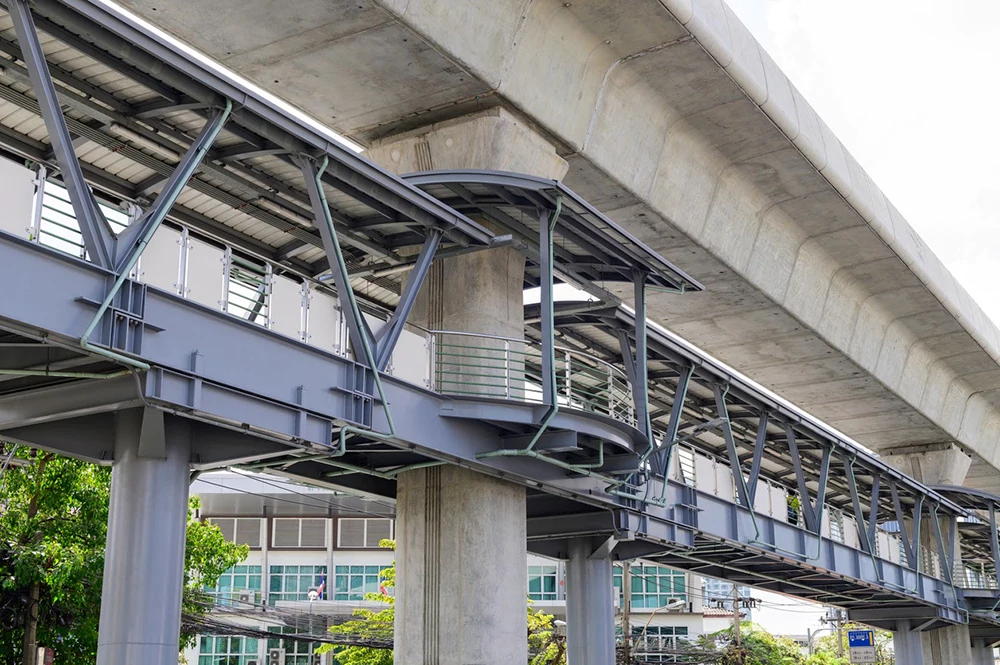
Elastomeric bearings for steel structures, walkways, beams and support points where forces must be controlled and transferred to the supporting structure. - Foundations and technical installations
Bearings for foundation points, technical installations and heavy equipment, with attention to compressive load, deformation and service life. - Vibration isolation in buildings
Bearings to reduce vibrations and impact sound from technical installations, ventilation units, generators and other equipment in industrial and utility buildings.



Ready to discuss your bearing project?
Send us your drawing, specification or application question. You will receive technical advice and a non-binding quotation. Also for one-off projects or specific structures. Would you like personal advice? Feel free to contact our experts.